
Block Puzzle Combos Explained: How to Multiply Your Score
If you compare two players with similar skill, the one with the higher score is almost always the one who understands combos. Clearing a line is good. Clearing lines move after move is where the real points are.
This article explains what a combo is, how it is usually scored, and how to build chains on purpose instead of by luck.
What is a combo?
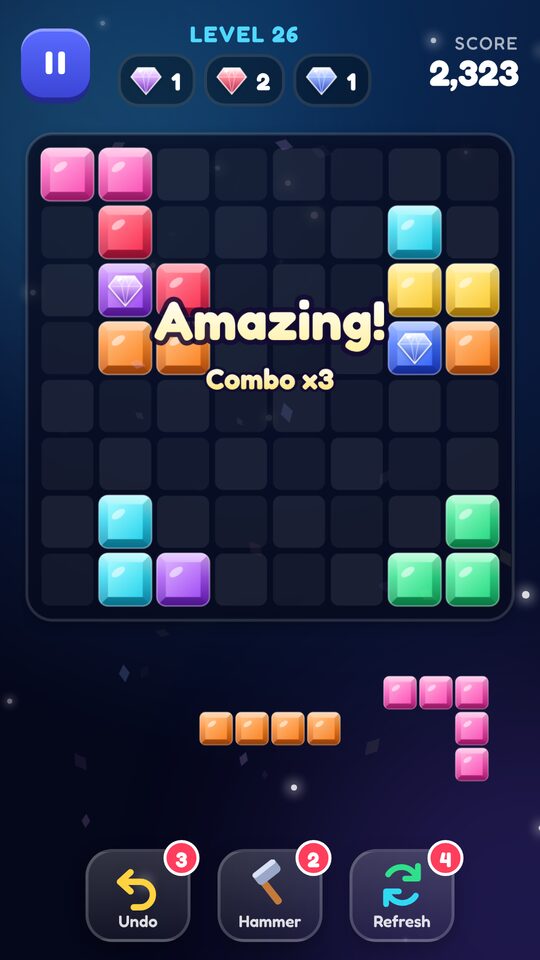
In most block puzzle games, a combo happens when you clear at least one line on consecutive moves. The first clear starts the chain, the second clear makes it a combo, and each additional clear pushes the multiplier higher.
Games differ in the details. Some reset the combo as soon as you place a piece without clearing anything. Others, like Gem Garden, give you a small grace period: you can place a couple of pieces without a clear before the chain breaks. Either way, the principle is the same — steady clearing is rewarded.
Combos vs. multi-line clears
These are two different things, and the best scores use both:
- A multi-line clear is one piece completing two or more lines at once. It is a big burst of points.
- A combo is clearing lines on several moves in a row. It is a growing multiplier.
A double clear in the middle of a combo is the best of both worlds.
How to start a combo chain
The key idea is simple: prepare several lines that are one piece away from clearing, then clear them one after another.
Step 1: Build "almost lines"
Fill two or three rows (or columns) until each is missing only a few cells. Do not clear them yet if you have a safe alternative.
Step 2: Match the gaps to your tray
Look at the pieces in your tray. Which gap does each one complete? A 1x2 bar might finish one row, a small L another, a single square the third.
Step 3: Clear in sequence
Place the pieces one after another so each one clears a line. Three pieces, three clears — and your combo is already climbing.
How to keep it going
Always leave a "next line"
When you clear a line, check whether another line is close to completion. If not, use your next piece to build one rather than placing it randomly.
Use both directions
Columns are easy to forget. After a row clears, the cells above and below often leave columns that are close to complete. Some of the best chains alternate rows and columns.
Do not sacrifice safety
A long combo is exciting, but a crowded board is dangerous. If the only way to continue the chain leaves no room for a 3x3 square, it is usually better to break the combo and stay alive.
Common combo mistakes
- Clearing too early. Clearing every line the moment it is possible feels good, but leaves nothing ready for the next move.
- Waiting too long. Holding five nearly complete lines and then receiving a tray that fits none of them is a classic way to lose.
- Ignoring the tray. Your plan only works if the pieces you have can complete the gaps you built.
- Forgetting columns. Half the clearing opportunities on the board are vertical.
Practice drill
Try this in Classic mode:
- For the first ten moves, try to keep two rows nearly full at all times.
- Each time a tray appears, check whether any piece completes one of those rows.
- Count how many moves in a row you can clear something.
When you can reliably hit a three-move chain, try keeping three lines ready instead of two.
Combos in Adventure mode
Combos are not only for high scores. In gem and ice levels, a chain of clears through the right rows can collect several jewels or break several ice blocks in a few moves, which also saves pieces and earns more stars.
Try a few chains in Gem Garden online, and pair this with our score guide for Classic mode.