
12 Block Puzzle Tips and Strategies for Higher Scores
Once you know the rules of block puzzle, the next question is always the same: how do the best players keep going for so long? The answer is not reflexes. It is a handful of habits that keep the board flexible and turn ordinary moves into big scores.
Here are twelve strategies we use ourselves while testing our games. You do not need all of them at once. Pick two or three, practice them for a few games, then add more.
Board management
1. Build from the corners and edges
Corners are the safest places on the board because they only touch the rest of the grid on two sides. Filling them first keeps the center open for awkward pieces later.
2. Keep one big open area
Imagine you will receive the 3x3 square on your next turn. Is there a clean 3x3 space for it? Good players almost always keep at least one. If you cannot find one, your next priority is to clear lines until you can.
3. Avoid single-square holes
A hole that only a 1x1 piece can fill is a trap. Those small pieces do not appear often, and the hole blocks the entire row and column from clearing. Before dropping a piece, check whether it leaves any isolated empty cells.
4. Fill rows and columns evenly
Instead of stacking one area very high, spread your pieces so that several rows are close to complete at the same time. That sets up multi-line clears and gives every piece more options.
Planning your moves
5. Read the whole tray first
The three pieces in the tray are a puzzle on their own. Sometimes the obvious first move makes the third piece impossible to place. Spend two seconds on order: big pieces first is often, but not always, the right call.
6. Place the hardest piece while you still have space
The 3x3 square, the 1x5 bars and the large L shapes get harder to place as the board fills. If one of them is in your tray and the board is fairly open, place it now.
7. Think one tray ahead
You cannot see the next tray, but you can predict what kinds of pieces you will need space for. After each move, ask: "Can a long bar still fit somewhere? A square? An L?" If the answer is no to two of those, clear something.
Scoring big
8. Set up double and triple clears
Clearing two or three lines with one piece is worth far more than clearing them one by one. A classic setup is two rows that are each missing the same two cells — one 1x2 piece completes both.
9. Chain combos
Most games reward clearing lines on consecutive moves. Even small single-line clears count. If you can clear something with every piece in a tray, your multiplier keeps climbing.
10. Go for the perfect clear — when it is safe
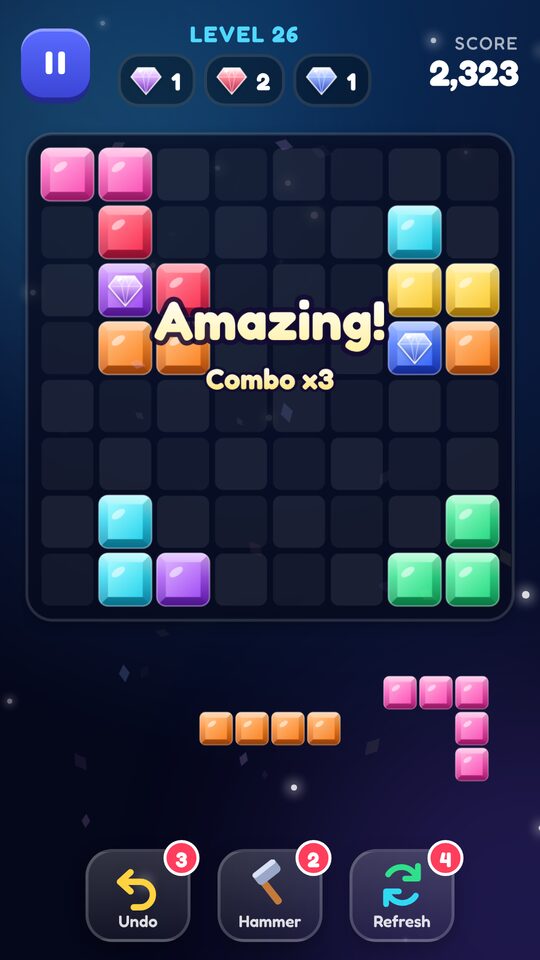
Some games, including Gem Garden, give a large bonus for emptying the whole board. It happens more often than you might think near the start of a game, when only a few pieces are on the grid. Never risk a full board chasing it, though.
Mindset
11. Slow down when the board is crowded
There is no timer, so use it. When the board is more than half full, every move deserves a moment of thought. Most game overs come from one rushed placement.
12. Learn from every game over
When a game ends, look at the board before starting a new one. Which piece could not fit, and why? Was there a hole, a missing 3x3 space, or a row that was never going to clear? Naming the mistake is the fastest way to stop repeating it.
A simple routine to practice
If you want a structured way to improve, try this for a week:
- Play three classic games a day.
- In the first game, focus only on corners and edges.
- In the second, focus on keeping a 3x3 space open.
- In the third, try to make at least one double clear.
- Write down your best score each day.
Most players see a clear improvement within a few days, simply because they start noticing what the board needs.
Put it into practice
Strategies stick when you use them. Try them in Gem Garden’s Classic mode online, or start with Adventure mode, where each level’s goal nudges you toward a different skill. If you are still learning the basics, our beginner’s guide covers the rules step by step.