
How to Play Block Puzzle: A Complete Beginner’s Guide
Block puzzle games look simple: a grid, a few colorful shapes, and one goal — keep the board from filling up. That simplicity is exactly why millions of people play them every day. But if you have ever lost a game after five minutes and wondered what went wrong, this guide is for you.
We build block puzzle games at Miwen Studio, so we spend a lot of time watching new players learn. Below are the rules, how points work, and the small habits that make the biggest difference in your first week.
The basic rules
Almost every modern block puzzle follows the same pattern:
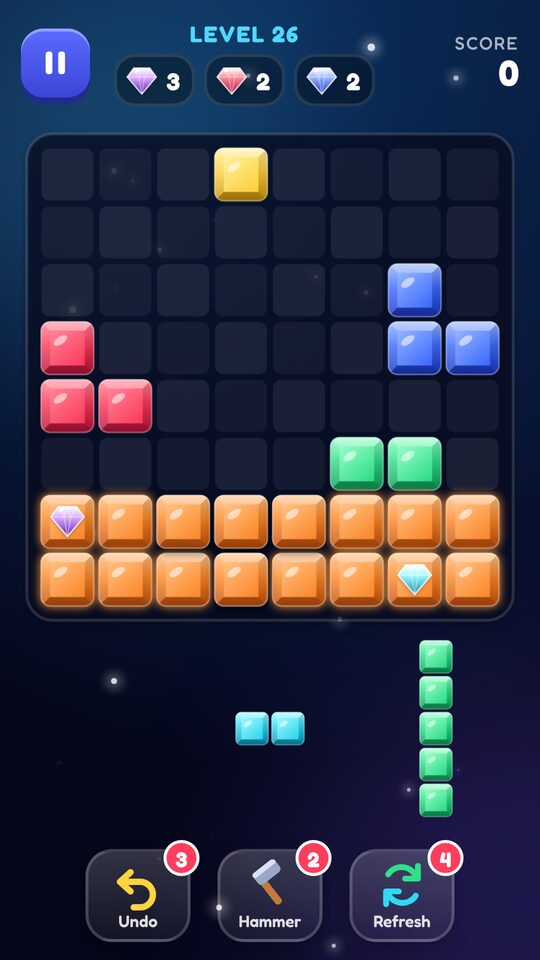
- You play on a square grid. The most common size is 8x8, though some games use 9x9 or 10x10.
- At the bottom of the screen you get a tray of three pieces. Pieces are made of small squares, a bit like the shapes in Tetris.
- You drag a piece onto the board and drop it in any empty space where it fits completely.
- When a full row or a full column is filled, it clears and you earn points.
- When all three pieces are used, you get three new ones.
- The game ends when none of your remaining pieces fit anywhere on the board.
There is no gravity and usually no timer. Pieces stay where you place them, and you cannot rotate them. That last point surprises many beginners: the shape you are given is the shape you must use.
How scoring usually works
Each game has its own formula, but the logic is similar everywhere:
- You get a few points for every square you place.
- Clearing a line gives a much bigger reward.
- Clearing several lines with one piece gives more than clearing them one at a time.
- Clearing lines on consecutive moves builds a combo that multiplies your score.
In other words, the game rewards planning. Placing pieces quickly is fine, but setting up two or three lines that clear together is where high scores come from.
Your first five habits
1. Look at all three pieces before moving
The order in which you place pieces matters. A long 1x5 bar might fit perfectly now but block the only spot your 3x3 square could use. Before you touch anything, scan the tray and imagine where each piece will go.
2. Keep the board open
Beginners tend to scatter pieces all over the grid. That creates small holes that only a single square can fill. Try instead to build from the edges and corners, and keep a large open area in the middle.
3. Respect the big pieces
The 3x3 square and the long 1x5 bars are the hardest pieces to place. Always ask yourself: "If a 3x3 square appears next turn, where will it go?" If the answer is "nowhere," it is time to clear some lines.
4. Clear lines early, not perfectly
Waiting for the perfect multi-line clear is tempting, but a board that is 80% full is one bad tray away from game over. When space gets tight, take the simple single-line clear.
5. Use the line preview
Many modern games — including our own Gem Garden — highlight the rows and columns that will clear before you drop a piece. Hover a piece over the board and watch for the glow. It is the easiest way to spot clears you would otherwise miss.
Classic mode vs. level-based mode
Most block puzzle games offer two styles of play:
- Classic (endless) mode – one long game where you try to beat your best score. There is no finish line; you play until no piece fits.
- Adventure or level mode – a series of short levels with a specific goal, such as collecting gems, breaking ice blocks or reaching a target score.
If you are just starting, level modes are a great teacher. Each level is short, the goals push you to try new strategies, and losing only costs you a minute. Classic mode is where you go to test everything you have learned.
Common beginner questions
Can I rotate pieces? In most block puzzles, no. Learning to work with fixed shapes is part of the challenge.
Is there a time limit? Usually not. You can take as long as you like before each move, which is why these games are so relaxing.
Is it luck or skill? Both. You cannot control which pieces appear, but good players keep the board flexible enough that almost any piece has a home. Over many games, skill wins.
How long is a game? A level usually takes one to three minutes. A classic run can last anywhere from five minutes to much longer once you get good.
Where to practice
The best way to learn is to play a few short games and pay attention to why each one ended. Was it a 3x3 square with nowhere to go? Too many single-square holes? Once you can name the problem, you can fix it.
You can play Gem Garden free in your browser — no download needed — or read our 12 strategies for higher scores when you are ready for the next step.