
Block Puzzle vs. Tetris: What’s the Difference?
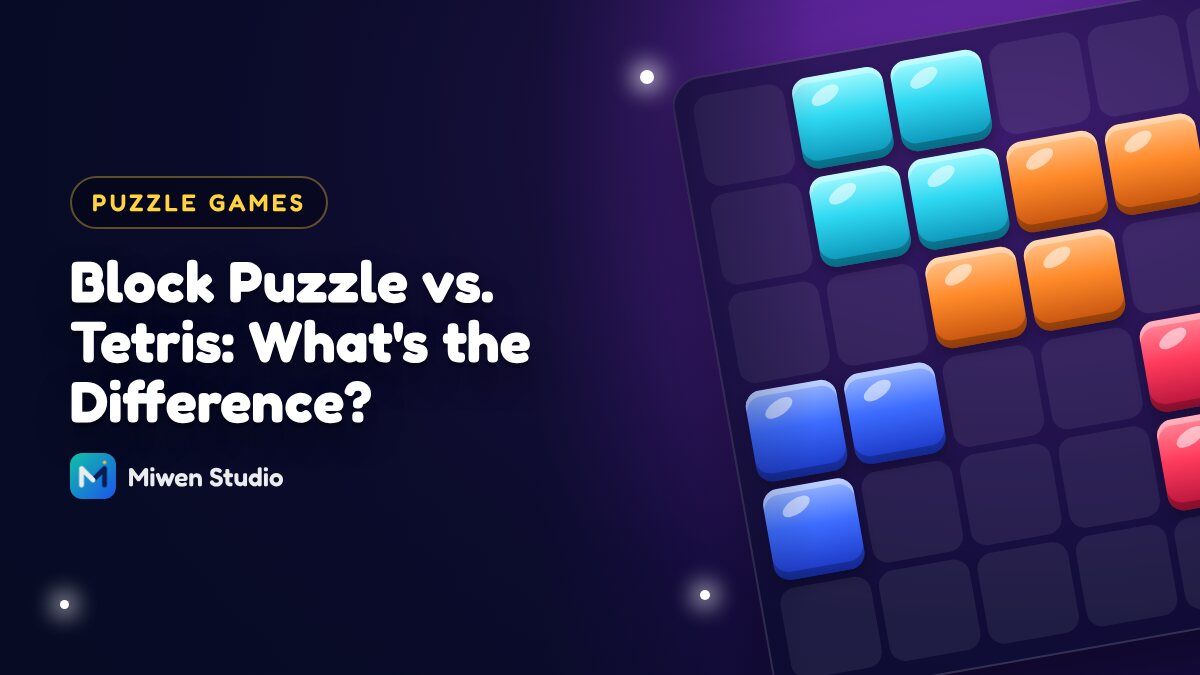
People often describe block puzzle games as "Tetris without the falling." That is a good starting point, but it only tells half the story. The two genres share a visual language — colorful squares, full lines that disappear — yet they feel completely different to play.
Here is a clear comparison, and why so many people who never enjoyed Tetris fall in love with block puzzles.
A quick look at the origins
Tetris was created by Alexey Pajitnov in 1984 and became one of the best-known video games ever made. Its pieces, called tetrominoes, are made of four squares each.
The idea of fitting shapes made of squares is even older. Mathematician Solomon Golomb popularized polyominoes — shapes made of joined squares — in the 1950s, and they have been used in puzzles and board games ever since. Modern block puzzle games borrow from both traditions: they use polyomino-style pieces of many sizes, placed on a grid like a board game.
The core differences
| Tetris | Block puzzle | |
|---|---|---|
| Movement | Pieces fall automatically | You drag and drop pieces anywhere |
| Time pressure | Constant, speeds up | Usually none |
| Rotation | Yes | Usually no |
| Lines that clear | Horizontal rows only | Rows and columns |
| Pieces | Always four squares | Many sizes, from 1 to 9 squares |
| Pieces visible | One upcoming piece (or a few) | Three pieces at once |
| Game over | Stack reaches the top | No piece in the tray fits |
Why it feels so different
No gravity, no rush
In Tetris, the piece is always falling. You have a second or two to decide, and the game gets faster as you improve. That makes it thrilling, but also stressful.
Block puzzles remove the clock. You can study the board for as long as you want before each move. This is the main reason they are so popular as relaxing games: you are in control of the pace.
Rows and columns
Because lines clear vertically as well as horizontally, the board is a true two-dimensional puzzle. A single piece can complete a row and a column at the same time, which opens up clever combinations that do not exist in Tetris.
No rotation
At first, not being able to rotate pieces feels like a limitation. In practice it changes the strategy: instead of fixing a piece to fit the board, you shape the board so it can accept any piece. Good block puzzle players think in terms of "keeping space," not "making a piece fit."
Three pieces at once
Seeing the whole tray turns each turn into a small planning puzzle. The order you place the three pieces can decide whether you survive the next round.
Which one is right for you?
Choose Tetris if you enjoy speed, reflexes and the rush of keeping up with a game that keeps accelerating.
Choose block puzzles if you prefer:
- playing at your own pace,
- short sessions you can pause at any moment,
- planning and spatial thinking over fast reactions,
- a calm game to unwind with.
Many players enjoy both. They use different skills, so getting better at one does not make you worse at the other.
Strategy that carries over
A few ideas work in both genres:
- Keep the surface flat. In Tetris that means an even stack; in block puzzles it means rows filled evenly.
- Avoid holes. A single gap that cannot be filled ruins a line in either game.
- Prepare multi-line clears. Both genres reward clearing several lines at once.
Try it yourself
If you have only ever played Tetris, the easiest way to feel the difference is to try a block puzzle for ten minutes. Gem Garden is free to play in your browser, and our tips and strategies article will help you get the hang of the no-rotation style quickly.